If you are looking for the best fiber internet Providers in the USA, 2026 offers more choices than ever. Fiber-optic internet is widely considered one of the best technologies for home broadband because it can deliver extremely fast download speeds, strong upload performance, low latency, and consistent connectivity.
Popular providers include GFiber (Google Fiber), AT&T Fiber, Verizon Fios, Frontier Fiber, Quantum Fiber, Brightspeed Fiber, and Optimum Fiber. However, the best provider depends heavily on your location because fiber availability varies by address.
According to recent 2026 comparisons, GFiber stands out for multi-gigabit performance, while Verizon Fios is a strong choice for value and reliability and AT&T Fiber has broad fiber availability.
Best Fiber Internet Providers in the USA 2026
| Provider | Typical Fiber Speeds | Best For |
|---|---|---|
| GFiber | 1–8 Gbps | Fastest & power users |
| AT&T Fiber | 300 Mbps–5 Gbps | Availability & overall performance |
| Verizon Fios | 300 Mbps–2.3 Gbps | Reliability & value |
| Frontier Fiber | Up to 7 Gbps | High-speed plans |
| Quantum Fiber | Up to multi-gigabit | Simple fiber plans |
| Brightspeed Fiber | Up to multi-gigabit | Growing fiber markets |
| Optimum Fiber | Up to multi-gigabit | Select Northeast markets |
Speeds, pricing, and availability vary by location and plan.
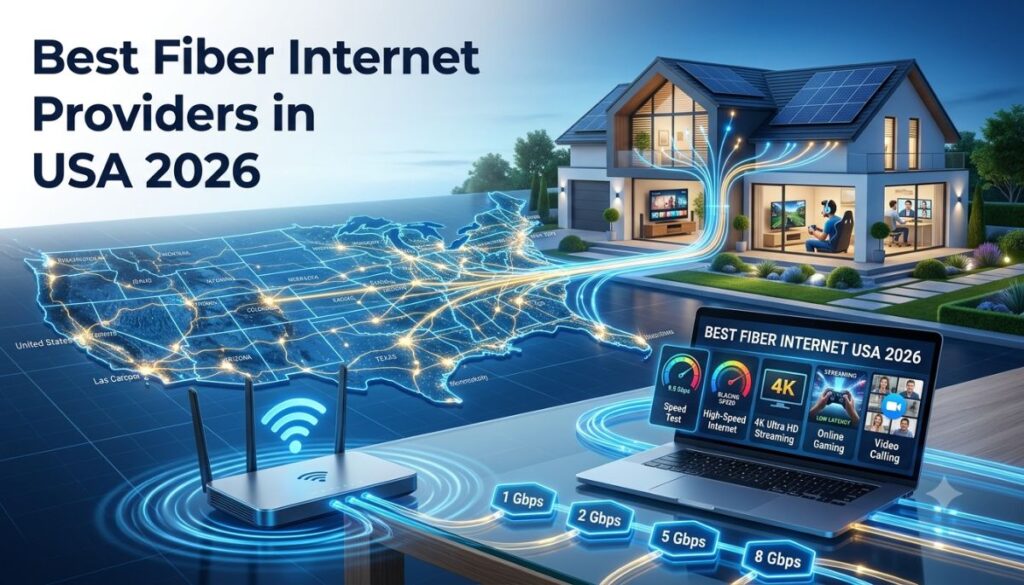
1. GFiber – Best Overall Fiber Internet
GFiber, formerly known as Google Fiber, is one of the strongest choices for customers who want fast, reliable and high-performance fiber internet.
Current 2026 comparisons list GFiber with speeds ranging from 1 Gbps to 8 Gbps, depending on the market. Its major advantage is its multi-gigabit performance and straightforward pricing structure.
Why Choose GFiber?
- Up to 8 Gbps in select locations
- Symmetrical upload and download speeds
- Excellent choice for gaming and streaming
- Great for large families
- Strong option for creators and remote workers
- Multi-gigabit plans available in selected cities
Pros
- Extremely fast speeds
- Excellent upload performance
- Good for heavy internet users
- Competitive pricing for high-speed service
Cons
- Limited availability
- Multi-gigabit speeds require compatible equipment
Best for: Power users, gamers, streamers and large households.
2. AT&T Fiber – Best for Availability
AT&T Fiber is one of the best choices if you want fast fiber internet with wider availability.
AT&T currently advertises fiber speeds up to 5 GIG in select areas, along with no annual contract and no data caps on its fiber service.
Recent 2026 comparisons list AT&T Fiber plans from around 300 Mbps through multi-gigabit tiers, depending on location.
AT&T Fiber Highlights
- Speeds up to 5 Gbps in eligible locations
- Unlimited data
- No annual contract
- Symmetrical upload/download speeds on fiber
- Equipment included with qualifying plans
- Strong availability compared with many competing fiber providers
Best for: Families, remote workers and customers who want a widely available fiber provider.
3. Verizon Fios – Best for Value & Reliability
Verizon Fios is another excellent fiber internet provider in the USA. Fios uses a fiber-to-the-home network and offers symmetrical speeds.
2026 comparisons show Fios plans ranging from roughly 300 Mbps to 2.3 Gbps, depending on location.
Verizon Fios Benefits
- Fast symmetrical speeds
- No data caps on listed Fios plans
- Strong reliability
- Good latency for gaming
- Competitive promotions
- Multi-gigabit options in selected areas
Best for: Families, gamers and customers looking for a reliable fiber connection.
4. Frontier Fiber – Best High-Speed Alternative
Frontier Fiber is worth considering if GFiber, AT&T Fiber or Verizon Fios isn’t available at your address.
Current 2026 comparisons list Frontier Fiber with speeds reaching up to 7 Gbps in some markets, making it an attractive option for customers who want very high bandwidth.
Best for: Customers who want high-speed fiber where Frontier has coverage.
5. Quantum Fiber – Good for Simple Fiber Service
Quantum Fiber is another provider to check when shopping for fiber internet in the USA.
It can be particularly attractive for customers who prefer straightforward fiber plans and high upload speeds. Current 2026 comparisons list plans such as 500 Mbps and 1 Gbps, with availability varying by location.
Best for: Customers looking for simple fiber service and strong everyday performance.
6. Brightspeed Fiber
Brightspeed is expanding its fiber network across multiple U.S. markets. It can be an excellent option where its fiber network has reached your address.
Current 2026 industry comparisons show Brightspeed among the fiber providers available in the U.S., while its network continues to expand.
Best for: Customers in areas where Brightspeed Fiber is available.
Best Fiber Internet Plans by User Type
| User Type | Recommended Speed | Best Provider Options |
|---|---|---|
| Single user | 300–500 Mbps | AT&T Fiber, Verizon Fios |
| Small family | 500 Mbps–1 Gbps | GFiber, AT&T Fiber, Verizon Fios |
| Large family | 1 Gbps | GFiber, AT&T Fiber, Verizon Fios |
| Online gaming | 500 Mbps–1 Gbps | GFiber, Verizon Fios |
| Remote work | 300–500 Mbps | AT&T Fiber, Verizon Fios |
| 4K streaming | 500 Mbps–1 Gbps | Most major fiber providers |
| Content creator | 1–2 Gbps+ | GFiber, AT&T Fiber |
| Power user | 2–8 Gbps | GFiber, Frontier Fiber |
What Makes Fiber Internet Better?
Fiber internet transmits data using optical fiber, allowing providers to deliver very high speeds. The FCC describes fiber-to-the-premises as a technology capable of offering the highest speeds among currently available fixed broadband technologies.
Fiber is especially useful for:
- 4K and 8K streaming
- Online gaming
- Video conferencing
- Uploading large files
- YouTube content creation
- Cloud backups
- Multiple connected devices
- Smart-home devices
Another major advantage is upload speed. Many fiber services offer symmetrical download and upload speeds, which can be particularly useful for video calls, livestreaming and uploading large video files.
300 Mbps vs 500 Mbps vs 1 Gig: Which Speed Should You Choose?
300 Mbps
A 300 Mbps fiber plan is enough for most small households. It can comfortably handle streaming, browsing, video calls and multiple connected devices.
500 Mbps
500 Mbps is a great middle-ground option for families. It provides additional bandwidth for multiple simultaneous users and high-quality streaming.
1 Gig
A 1 Gbps plan is ideal for large households, gamers, content creators and people with many connected devices.
2 Gbps or More
Multi-gigabit plans are mainly useful for power users, professional creators, large households and users transferring very large files frequently.
The FCC currently uses 100 Mbps download / 20 Mbps upload as its fixed broadband benchmark, while identifying a long-term goal of 1 Gbps download and 500 Mbps upload.
How Much Does Fiber Internet Cost in the USA?
Fiber pricing varies considerably by provider, location, speed and promotional offers. Recent 2026 comparisons show examples such as:
| Provider | Example Starting Price* | Example Speed |
|---|---|---|
| GFiber | Around $70/mo. | 1 Gbps |
| Verizon Fios | Around $49.99/mo. | 300 Mbps |
| AT&T Fiber | Around $35/mo. promotional | 300 Mbps |
| Quantum Fiber | Around $50/mo. | 500 Mbps |
| Frontier Fiber | Around $64.99/mo. | 1 Gbps |
*Prices are examples from current 2026 market comparisons and can change by location, promotion, taxes, equipment and eligibility.
How to Check Fiber Internet Availability
Fiber availability is extremely location-dependent. Even if a provider offers fiber in your city, its fiber network may not reach your particular neighborhood or address.
The FCC’s National Broadband Map lets consumers enter an address and see internet providers, technologies and advertised speeds available at that location.
Before choosing a plan, check:
- Fiber availability at your exact address
- Download speed
- Upload speed
- Monthly price
- Promotional-period pricing
- Equipment fees
- Installation charges
- Contract requirements
- Data caps
- Multi-gig compatibility
Which Is the Best Fiber Internet Provider in the USA?
There isn’t one provider that is best for every American household.
GFiber is an excellent choice if you want extremely fast multi-gigabit service and it is available at your address. AT&T Fiber is a strong overall option with broad availability and speeds up to 5 Gbps in select areas. Verizon Fios is a strong choice for customers who prioritize reliable symmetrical fiber service and competitive pricing.
Our Overall Ranking
- GFiber – Best overall for speed
- AT&T Fiber – Best for availability
- Verizon Fios – Best for value and reliability
- Frontier Fiber – Best high-speed alternative
- Quantum Fiber – Best for straightforward fiber plans
- Brightspeed Fiber – Best for expanding fiber markets
- Optimum Fiber – Good regional option
Frequently Asked Questions
Is fiber internet better than cable?
Generally, yes. Fiber can offer higher speeds, better upload performance and lower latency than many cable connections. However, the actual experience depends on the provider, plan and local network.
Is 1 Gbps fiber internet worth it?
For a large family, gamer, remote worker or content creator, 1 Gbps can be worthwhile. For a small household with basic browsing and streaming needs, 300–500 Mbps may provide better value.
What is the fastest fiber internet in the USA?
Some providers now offer multi-gigabit fiber plans. GFiber offers speeds up to 8 Gbps in selected markets, while AT&T Fiber advertises up to 5 Gbps in eligible areas.
Does fiber have better upload speeds?
Yes. A major advantage of fiber is that many plans provide symmetrical or near-symmetrical upload and download speeds.
Is fiber good for gaming?
Yes. Fiber is an excellent choice for gaming because of its high speeds and typically low latency. However, latency also depends on the game server, routing, Wi-Fi connection and other network factors.
Final Verdict
If you’re searching for the best fiber internet in the USA in 2026, start by checking GFiber, AT&T Fiber and Verizon Fios at your address.
GFiber is our top pick for users who want maximum speed. AT&T Fiber is a strong choice for availability and all-around performance, while Verizon Fios remains an excellent option for value and reliability.
The most important rule is simple: don’t choose a provider based only on its advertised maximum speed. Compare the actual plans available at your address, including upload speed, monthly price, equipment costs, promotions and contract terms.