Finding the best broadband service in the USA in 2026 depends on more than just download speed. Price, reliability, upload speed, availability, data limits, equipment fees and customer service can all make a big difference.
The good news is that broadband value has improved. USTelecom’s 2026 Broadband Pricing Index found that inflation-adjusted prices for popular 100–940 Mbps services fell 6% year over year in 2025, while gigabit pricing also declined in real terms.
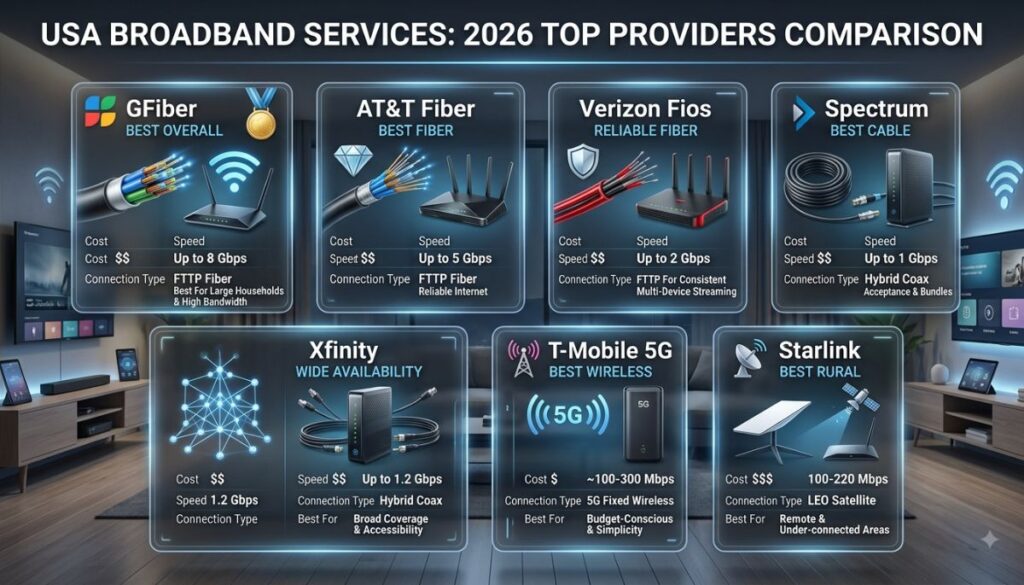
In this guide, we’ll compare the best broadband providers in the USA in 2026, including GFiber, AT&T Fiber, Verizon Fios, Spectrum, Xfinity, T-Mobile 5G Home Internet and Starlink, with their typical prices, speeds and best use cases.
Note: Internet availability and pricing vary by ZIP code. Promotional pricing, AutoPay discounts, equipment charges, taxes and post-promotion prices can also affect your final bill.
Best Broadband Providers in USA 2026
| Provider | Connection | Starting Price* | Typical/Advertised Speed | Best For |
|---|---|---|---|---|
| GFiber | Fiber | From about $55/mo. | 1–8 Gbps | 🏆 Best Overall |
| AT&T Fiber | Fiber | From about $35–$45/mo. | 300 Mbps–5 Gbps | Best Fiber Alternative |
| Verizon Fios | Fiber | From about $50/mo. | 300 Mbps–2.3 Gbps | Reliability |
| Spectrum | Cable | From about $40/mo. | Up to 1 Gbps+ | Budget Cable |
| Xfinity | Cable/Fiber | Varies | Up to multi-gigabit | Wide Availability |
| T-Mobile 5G Home Internet | 5G Fixed Wireless | From about $50/mo. | Up to about 500 Mbps | Budget & Easy Setup |
| Starlink | Satellite | From about $55/mo. | Up to about 400 Mbps | Rural Internet |
*Starting prices are approximate and can vary by location, promotions and plan terms. Current 2026 comparisons list GFiber at $55/month, AT&T Fiber at $35/month, Spectrum at $40/month, T-Mobile 5G Home Internet at $50/month and Starlink at $55/month.
🏆 1. GFiber – Best Broadband Service Overall
GFiber is one of the best choices for people who want extremely fast fiber internet.
Current 2026 comparisons list GFiber speeds from 1 Gbps to 8 Gbps, with plans starting around $55 per month in eligible markets.
Why GFiber is a Top Choice
- Fiber-optic connection
- 1 Gbps to multi-gigabit speeds
- Excellent upload performance
- Low latency
- No traditional data caps on its standard fiber service
- Excellent for gaming
- Great for large families
- Excellent for 4K/8K streaming
GFiber has limited availability, however, so you should check your address before making it your first choice.
Best for
Families, gamers, streamers, remote workers and content creators.
⚡ 2. AT&T Fiber – Best Fiber Alternative
AT&T Fiber is another excellent broadband option in the USA.
Current comparisons list AT&T Fiber speeds from around 300 Mbps to 5 Gbps, with prices starting around $35–$45 per month, depending on the market and plan.
AT&T Fiber also performed strongly in 2026 Speedtest-based testing. A report based on Ookla data from January through June 2026 ranked AT&T Fiber first among several major providers with a Connectivity Score of 82.90, ahead of Verizon Fios at 80.82, Cox at 78.53, Xfinity at 78.24 and Spectrum at 76.92.
Best for
- Work from home
- Online gaming
- Families
- 4K streaming
- Video calls
- Multiple devices
- Content creation
If AT&T Fiber and another fiber provider are available at your address, compare their actual monthly costs and upload speeds before choosing.
🔴 3. Verizon Fios – Best for Fiber Reliability
Verizon Fios remains one of the major fiber choices in the USA.
Current comparisons list Fios speeds from approximately 300 Mbps to 2.3 Gbps, with pricing starting around $49.99/month with AutoPay on eligible plans.
Because Fios uses fiber, it is particularly attractive to households that need strong upload performance.
Best for
- Families
- Gamers
- Remote workers
- Streaming households
- Video conferencing
- Multiple connected devices
The main limitation is availability because Fios isn’t offered throughout the entire country.
📺 4. Spectrum – Best Cable Broadband Option
If fiber isn’t available at your address, Spectrum can be a strong alternative.
Current 2026 comparisons list Spectrum starting around $40/month, with speeds depending on the market and selected plan. Reviews.org currently identifies Spectrum as a good value where fiber isn’t available.
Advantages
- Broad availability
- Good download speeds
- Unlimited-data options on standard plans
- Good family internet
- No fiber installation required
Best for
Families who want affordable high-speed internet but don’t have access to fiber.
The main disadvantage compared with fiber is generally weaker upload performance.
🚀 5. Xfinity – Best for Flexible Plan Choices
Xfinity is one of America’s largest broadband providers and has extensive cable coverage.
Its exact plans and prices vary significantly by location, so shoppers should check the plans available at their ZIP code.
Xfinity can be attractive for people who want:
- Fast download speeds
- Multiple plan choices
- Broad availability
- Internet and entertainment bundles
- Flexible speed options
Before signing up, compare the promotional price, regular price, equipment charges and contract requirements.
📱 6. T-Mobile 5G Home Internet – Best Budget Alternative
If fiber and cable aren’t attractive or available, T-Mobile 5G Home Internet is one of the most interesting alternatives.
Current 2026 comparisons list the service from around $50/month with AutoPay, with advertised download speeds reaching roughly 500 Mbps depending on location. Reviews.org also highlights its simple setup and five-year price guarantee.
Benefits
- Easy installation
- No traditional cable line required
- Competitive monthly pricing
- Good option for renters
- No complicated wired installation
- Useful alternative to cable
Actual performance depends on local 5G coverage, signal strength and network congestion.
Best for
Budget-conscious users, renters and households without fiber.
🛰️ 7. Starlink – Best Broadband for Rural Areas
For homes in rural areas where fiber and cable aren’t available, Starlink can be an important broadband option.
Current comparisons list Starlink from about $55/month, with advertised speeds of up to around 400 Mbps depending on the service and location.
Best for
- Rural homes
- Farms
- Remote locations
- Areas without cable or fiber
- RV and portable internet users
Starlink is generally more expensive than many wired broadband options, but its biggest advantage is availability in places traditional providers don’t reach.
💰 Best Affordable Broadband Plans in USA 2026
If your priority is saving money, you don’t necessarily need gigabit internet.
For many households, 300–500 Mbps provides plenty of capacity for streaming, browsing, video calls and gaming.
Recommended Speed by Household
| Household | Recommended Speed |
|---|---|
| 1–2 people | 100–300 Mbps |
| Small family | 300–500 Mbps |
| Large family | 500 Mbps–1 Gbps |
| Heavy streaming | 500 Mbps–1 Gbps |
| Gaming + large downloads | 500 Mbps+ |
| Power users | 1 Gbps+ |
The best choice isn’t always the cheapest advertised plan. Consider the long-term monthly price, equipment costs and any promotional price increases.
Fiber vs Cable vs 5G vs Satellite
Fiber Internet
⭐ Best Overall Technology
Fiber generally provides the best combination of speed, reliability, latency and upload performance.
If fiber is available at a reasonable price, it should usually be your first choice.
Cable Internet
⭐ Best Widely Available Alternative
Cable internet can provide fast download speeds and is available in many areas where fiber hasn’t reached yet.
5G Home Internet
⭐ Best Flexible Alternative
5G home internet can be easy to install and competitively priced. However, performance can vary depending on local wireless conditions.
Satellite Internet
⭐ Best for Remote Locations
Satellite broadband is valuable where wired internet isn’t available. Starlink’s low-Earth-orbit network has made satellite internet considerably more practical than traditional satellite services.
What Internet Speed Do You Really Need?
You don’t necessarily need a 1 Gbps plan just because it’s available.
100 Mbps
Good for:
- 1–3 users
- HD streaming
- Video calls
- Online classes
- Browsing
- Social media
300 Mbps
Good for:
- Families
- Multiple streaming devices
- Gaming
- Work from home
- Smart TVs
- Several connected devices
500 Mbps
Good for:
- Large families
- Multiple 4K streams
- Heavy downloads
- Gaming
- Home offices
1 Gbps+
Best for:
- Very large households
- Content creators
- Large file transfers
- Multiple heavy users
- Multi-gigabit enthusiasts
How to Choose the Best Broadband Service in USA
Before ordering an internet plan, consider these factors.
1. Check Availability
The best provider is useless if it doesn’t service your address.
Always check availability using your ZIP code or complete address.
2. Compare the Real Monthly Cost
Don’t look only at the advertised starting price.
Check:
- Regular monthly price
- Promotional period
- Equipment fee
- Installation fee
- Taxes
- AutoPay requirements
- Contract requirements
Forbes’ 2026 broadband evaluation specifically recommends considering long-term pricing rather than focusing only on introductory rates.
3. Check Upload Speed
If you work from home, upload videos or frequently use cloud services, upload speed matters.
This is one reason fiber is particularly attractive.
4. Check Data Limits
Some internet plans have unlimited data, while others may have restrictions or additional charges.
5. Consider Customer Service
A cheap internet plan isn’t a good deal if service problems are difficult to resolve.
Consumer Reports’ latest ISP survey notes that customers report significant differences among providers in areas such as value and customer service.
Best Broadband Service USA 2026: Final Verdict
There is no single broadband provider that is perfect for every American household. Availability is the most important factor.
However, based on current 2026 pricing, performance comparisons and provider reviews:
| Category | Best Choice |
|---|---|
| 🏆 Best Overall | GFiber |
| ⚡ Best Fiber Alternative | AT&T Fiber |
| 🔴 Best Reliable Fiber | Verizon Fios |
| 💰 Best Cable Value | Spectrum |
| 📱 Best 5G Home Internet | T-Mobile 5G Home Internet |
| 🛰️ Best Rural Internet | Starlink |
| 🎮 Best for Gaming | Fiber Internet |
| 👨👩👧👦 Best for Families | 300–500 Mbps Fiber |
| 💵 Best Budget Approach | 100–300 Mbps plan |
Our Overall Recommendation
If fiber is available: choose GFiber, AT&T Fiber or Verizon Fios based on your local price and availability.
If fiber isn’t available: consider Spectrum or Xfinity.
If you want simple installation and flexible home internet: consider T-Mobile 5G Home Internet.
If you live in a rural area without wired broadband: Starlink may be the best practical choice.
Broadband pricing is also becoming more competitive. USTelecom’s 2026 index found that real prices for popular 100–940 Mbps services dropped 6% in 2025, while speeds continued to increase.
Frequently Asked Questions
What is the best broadband service in the USA in 2026?
GFiber is one of the strongest overall choices where available. AT&T Fiber and Verizon Fios are excellent alternatives, particularly for users who want fiber connectivity.
What is the cheapest broadband service in the USA?
Some providers offer entry-level plans around $35–$50 per month, although pricing varies by location, promotions and eligibility. T-Mobile 5G Home Internet, Spectrum and AT&T Fiber are among the providers with relatively low advertised starting prices in current 2026 comparisons.
Is 300 Mbps enough for a family?
Yes. 300 Mbps is enough for most families for streaming, gaming, video calls, browsing and multiple connected devices.
Is fiber better than cable?
Generally, yes. Fiber usually offers better upload speeds, low latency and excellent reliability. If fiber is available at a competitive price, it is usually the preferred technology.
Is T-Mobile 5G Home Internet good?
Yes, it can be a good option for households that want easy installation and competitive pricing. However, performance varies based on local 5G coverage and network congestion.
Is Starlink good for rural America?
Yes. Starlink is particularly useful where fiber, cable and other terrestrial broadband services aren’t available. It is usually more expensive than wired broadband, so it makes the most sense when conventional options are limited.