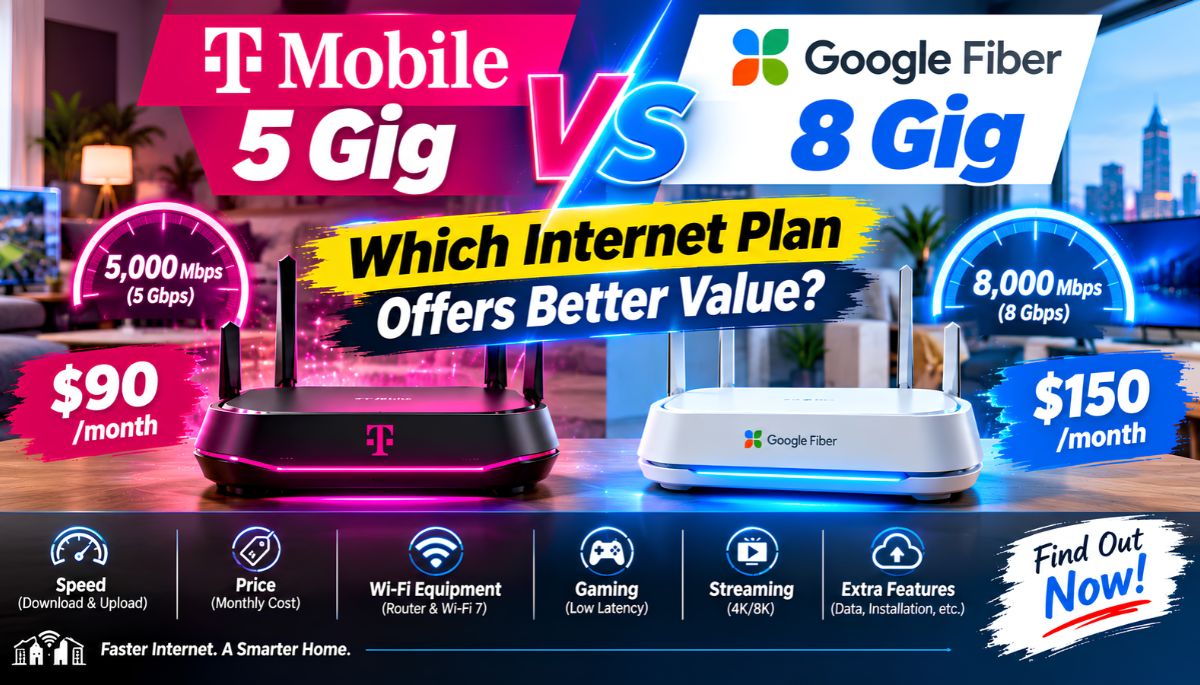
The race for faster home internet in the United States is getting more interesting. T-Mobile has introduced a new 5 Gig fiber internet plan for $90 per month, while Google Fiber continues to offer its powerful 8 Gig connection for $150 per month.
Both plans are designed for people who want extremely fast internet at home. They offer multi-gigabit speeds, making them attractive to gamers, content creators, remote workers and households with multiple connected devices.
But there is a big difference in their monthly prices.
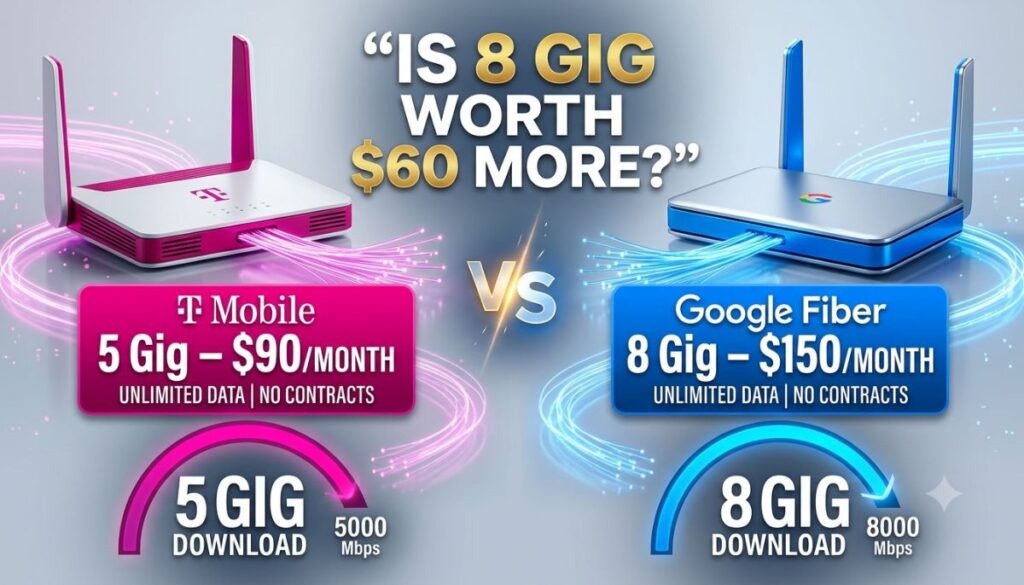
T-Mobile’s 5 Gig plan costs $60 less per month than Google Fiber’s 8 Gig option. That’s a potential saving of $720 per year.
So, is Google’s additional speed worth paying extra, or does T-Mobile offer a better deal?
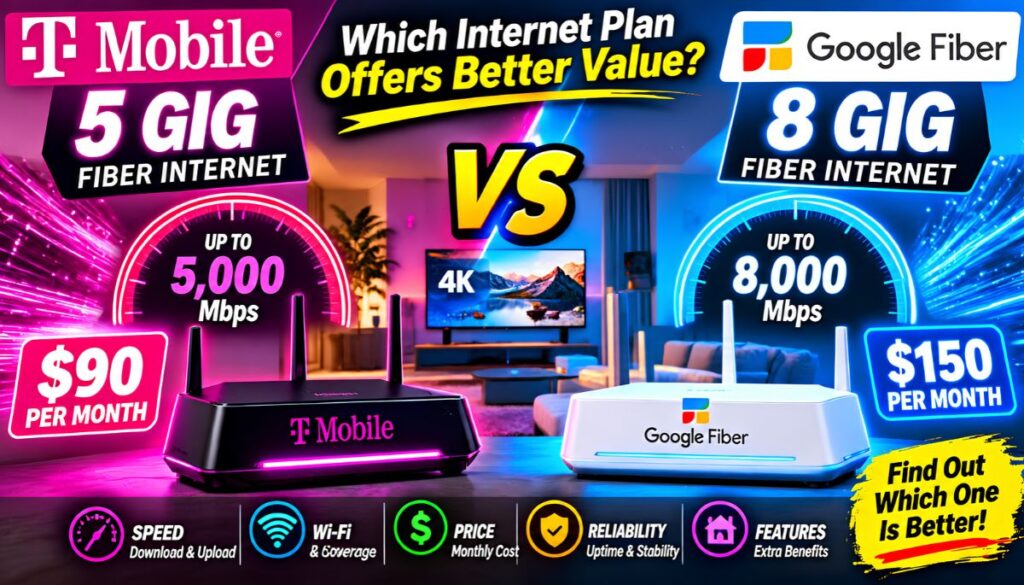
Let’s compare T-Mobile 5 Gig and Google Fiber 8 Gig across speed, price, features, equipment and real-world performance.
1. T-Mobile 5 Gig vs Google Fiber 8 Gig: Quick Comparison
| Feature | T-Mobile Fiber 5 Gig | Google Fiber 8 Gig |
|---|---|---|
| Maximum download speed | 5,000 Mbps | 8,000 Mbps |
| Maximum upload speed | 5,000 Mbps | 8,000 Mbps |
| Monthly price | $90 | $150 |
| Annual cost | $1,080 | $1,800 |
| Price difference | $60 cheaper | $60 more |
| Connection type | Fiber | Fiber |
| Upload performance | Symmetrical | Symmetrical |
| Unlimited data | Yes | Yes |
| Wi-Fi equipment | Router included | Wi-Fi 7 router included |
| Installation | No extra charge | Free professional installation or self-setup |
| Contract | No annual contract | Check local terms |
| Best for | High-speed value | Extreme-speed users |
Prices are advertised monthly rates before applicable taxes and fees. Availability, promotional offers and equipment terms may vary by address.
T-Mobile’s 5 Gig plan launched on November 3, 2026, at $90 per month with AutoPay and a 10-year price guarantee. Google Fiber currently advertises its 8 Gig service at $150 per month.
2. T-Mobile 5 Gig Internet: What Do You Get for $90?
T-Mobile is making a serious move into the multi-gigabit fiber market with its new 5 Gig plan.
The company introduced the service as its fastest residential fiber internet option, targeting households that need more bandwidth for demanding online activities.
T-Mobile 5 Gig Plan Features
- Download speeds up to 5,000 Mbps.
- Upload speeds up to 5,000 Mbps.
- 100% fiber-optic connection.
- Unlimited data with no data caps.
- Wi-Fi router included.
- Professional installation at no additional cost.
- No annual contract.
- 10-year price guarantee.
- Mesh Wi-Fi extender for households that need it.
The biggest attraction is the price guarantee. T-Mobile says eligible customers signing up for the 5 Gig plan can lock in their monthly internet rate for 10 years, although taxes, fees and certain exclusions still apply.
The company also announced limited-time offers, including two months free through bill credits and $300 in virtual prepaid cards for eligible customers.
For someone looking for extremely fast internet without spending $150 every month, T-Mobile’s offer looks attractive.
3. Google Fiber 8 Gig Internet: Is It Worth $150?
Google Fiber has been a popular option among customers looking for high-speed fiber internet in supported US markets.
Its 8 Gig plan is designed for people who want some of the fastest residential internet speeds available.
Google Fiber 8 Gig Plan Features
- Download speeds up to 8,000 Mbps.
- Upload speeds up to 8,000 Mbps.
- Symmetrical fiber internet.
- Wi-Fi 7 router included.
- Multi-gigabit wireless capabilities.
- Unlimited data.
- Up to two mesh extenders as needed.
- Internet battery backup for up to two hours during power loss.
- 99.9%+ uptime guarantee under the plan’s terms.
One of the most interesting features is Google’s Wi-Fi 7 equipment. It is designed to provide faster wireless connectivity and better performance across multiple devices.
Google Fiber also advertises an uptime guarantee for its 8 Gig service. According to its published terms, customers can receive a 25% refund on their monthly bill if their internet is down for more than 45 minutes.
However, the biggest drawback is the price. At $150 per month, Google Fiber costs considerably more than T-Mobile’s new 5 Gig option.
4. Price Comparison: Which Provider Saves You More Money?
Price is probably the most important part of this comparison.
Let’s look at the advertised monthly and annual costs.
| Cost Comparison | T-Mobile 5 Gig | Google Fiber 8 Gig |
|---|---|---|
| Monthly price | $90 | $150 |
| 3-month cost | $270 | $450 |
| 6-month cost | $540 | $900 |
| 12-month cost | $1,080 | $1,800 |
| Annual difference | $720 savings | $720 extra |
T-Mobile offers a substantial price advantage.
Customers choosing T-Mobile instead of Google Fiber could save approximately $720 annually before taxes and any promotional adjustments.
That is enough money to purchase a new laptop, gaming monitor, smartphone or other home technology.
Google Fiber does offer 60% more maximum bandwidth, but customers must decide whether that additional capacity is worth the higher subscription price.
5. Download Speed Test: How Much Faster Is 8 Gig Than 5 Gig?
On paper, Google Fiber is clearly faster.
Its 8 Gig plan offers 3,000 Mbps more bandwidth than T-Mobile’s 5 Gig connection.
Let’s take an example using a 100GB file.
Under ideal theoretical conditions:
| Download Example | T-Mobile 5 Gig | Google Fiber 8 Gig |
|---|---|---|
| 10GB file | 16 seconds | 10 seconds |
| 50GB file | 80 seconds | 50 seconds |
| 100GB file | 160 seconds | 100 seconds |
These are theoretical estimates, not guaranteed real-world download times.
Actual speeds depend on the server, computer, network congestion, router and connection type.
For people who regularly download massive files, Google’s extra bandwidth could save valuable time.
For everyday browsing, streaming and social media, the difference may be difficult to notice.
6. Which Internet Plan Is Better for Gaming?
Both plans offer more than enough bandwidth for online gaming.
However, gaming performance is not determined by download speed alone.
Latency, jitter, packet loss and network stability are much more important for competitive multiplayer games.
T-Mobile’s 5 Gig fiber connection can easily support gaming alongside streaming, video calls and large downloads.
Google Fiber’s 8 Gig plan offers additional capacity, which can be useful in households where several people are performing demanding online activities simultaneously.
Our recommendation: Choose T-Mobile for better value. Choose Google Fiber if you regularly handle huge downloads and need the additional bandwidth.
7. Wi-Fi 7 vs T-Mobile Fiber Equipment
Another important difference is the home networking equipment.
Google Fiber’s 8 Gig plan includes a Wi-Fi 7 router designed for multi-gigabit home networking.
Wi-Fi 7 supports technologies such as Multi-Link Operation, which can improve wireless performance on compatible devices.
T-Mobile also includes a Wi-Fi router and a mesh Wi-Fi extender for households that need one with its 5 Gig plan.
However, customers should check the exact router specifications and supported Ethernet ports before upgrading.
Remember, having an 8 Gig subscription does not mean your smartphone will automatically receive 8 Gbps over Wi-Fi.
Your router, device, Wi-Fi environment and network ports all affect actual performance.
8. Which Plan Is Better for Remote Work and Content Creators?
Both plans are excellent for professional internet users.
Because both services offer symmetrical speeds, upload performance is also extremely fast.
This is important for:
- Uploading 4K and 8K videos.
- Sending large files to clients.
- Cloud storage and backups.
- Video production and editing.
- Remote collaboration.
- Large software and game development projects.
For most remote workers, even a 1 Gig connection is sufficient.
However, professional creators and studios handling enormous files may benefit from the additional bandwidth offered by Google Fiber’s 8 Gig plan.
9. Availability: Can You Get T-Mobile 5 Gig or Google Fiber 8 Gig?
Availability is one of the biggest factors in choosing between these providers.
Both services are limited to areas where their fiber networks are available.
T-Mobile’s 5 Gig service started rolling out on November 3, 2026, with availability in select locations.
Google Fiber’s 8 Gig service is also available only in supported markets.
Before choosing a plan, check your exact home address on the provider’s official website.
- T-Mobile Fiber: https://fiber.t-mobile.com/
- Google Fiber: https://gfiber.com/
Do not assume that a provider’s presence in your city means your particular street or building is eligible.
10. Who Should Choose T-Mobile 5 Gig and Who Should Choose Google Fiber 8 Gig?
The best option depends on your household’s internet requirements and budget.
| User Type | Recommended Plan |
|---|---|
| Regular families | T-Mobile 5 Gig |
| Online gamers | T-Mobile 5 Gig |
| 4K streaming households | T-Mobile 5 Gig |
| Remote workers | T-Mobile 5 Gig |
| Budget-conscious power users | T-Mobile 5 Gig |
| Professional video editors | Google Fiber 8 Gig |
| Large content production studios | Google Fiber 8 Gig |
| Heavy cloud backup users | Either plan, depending on workload |
| Users wanting maximum bandwidth | Google Fiber 8 Gig |
These are general recommendations. Most households do not need either of these extremely fast plans, and a lower-priced gigabit option may provide better value.
Final Verdict: T-Mobile 5 Gig vs Google Fiber 8 Gig
T-Mobile and Google Fiber are offering two impressive fiber internet plans, but they target slightly different customers.
T-Mobile’s 5 Gig plan stands out because of its $90 monthly price, symmetrical speeds and 10-year price guarantee. It delivers plenty of bandwidth for gaming, streaming, remote work and demanding household internet usage.
Google Fiber’s 8 Gig plan is the better choice for customers who want maximum speed, advanced Wi-Fi 7 equipment and additional features such as internet battery backup and an uptime guarantee.
Our winner for value: T-Mobile 5 Gig.
At $90 per month, it offers a strong balance between speed and price. Google Fiber 8 Gig is worth considering if you genuinely need the extra 3 Gbps and can justify spending an additional $60 every month.
For most customers, saving $720 per year while still getting 5 Gbps is a very attractive deal.
Frequently Asked Questions (FAQs)
1. Is T-Mobile 5 Gig cheaper than Google Fiber 8 Gig?
Yes. T-Mobile advertises its 5 Gig plan for $90 per month, while Google Fiber advertises its 8 Gig plan for $150 per month. The difference is $60 per month before applicable taxes and fees.
2. Which internet is faster, T-Mobile 5 Gig or Google Fiber 8 Gig?
Google Fiber is faster on paper, offering up to 8,000 Mbps compared with T-Mobile’s 5,000 Mbps.
3. Does T-Mobile 5 Gig offer symmetrical speeds?
Yes. T-Mobile advertises symmetrical fiber speeds, meaning upload and download speeds can both reach 5 Gbps.
4. Does Google Fiber 8 Gig include Wi-Fi 7?
Yes. Google Fiber includes its multi-gigabit Wi-Fi 7 router with its 8 Gig plan.
5. Which is better for gaming?
Both plans are excellent for gaming. However, latency and network stability are generally more important than maximum bandwidth.
6. Does T-Mobile offer a 10-year price guarantee?
Yes. T-Mobile advertises a 10-year price guarantee for its 5 Gig plan, subject to the terms and exclusions.
7. Is Google Fiber 8 Gig worth $150 per month?
It can be worth it for professionals and households with demanding bandwidth needs. However, most families can save money with a slower plan.
8. Can I get 5 Gig or 8 Gig internet over Wi-Fi?
Compatible Wi-Fi 7 equipment can deliver multi-gigabit wireless performance under suitable conditions, but actual speeds depend on the device, distance and environment.
Read More:- T-Mobile Launches 5 Gig Fiber Internet for Just $90: 10-Year Price Guarantee